Nathaniel School of Music · Langford Town · Sahakar Nagar · Live online
Music courses in Bangalore · since 2008: The Music Method, a six-month course that makes a complete musician of you
Piano, guitar or vocals, built from the ground up: rhythm, chords and ear training come before melody. Foundation is 32 live lessons, 20 on your instrument and 12 on theory, ear training and rhythm. Every class is recorded and waits on your student portal with your homework, and the semester ends with a Music Method certificate.
I want to learn: Piano · Guitar · Vocals
See courses and fees · WhatsApp us

- 6,000+ Students taught
- 18+ Years teaching, since 2008
- 120,000+ YouTube subscribers
- 20+ Countries reached
- 2 Bangalore studios, plus live online
On this page: The Method · Syllabus · Fees · Portal and apps · Why us · Since 2008 · Reviews · FAQ
The Music Method: A course built in the right order.
The Music Method is our own course, taught at the school since 2009. It is performance-based and skill-first: your hands, your understanding and your ear are trained together in every lesson, so you know what you are playing and can use it with other musicians.
- Rhythm and harmony first. We start with rhythm, chords and ear training, and bring in melody once they are in place. On piano you play with both hands from the very first class.
- Technique, theory and ear in one lesson. We call it 3D learning. Theory is never saved for later: it is in the same lesson as the exercise it explains.
- Recorded, with homework that gets marked. Every class is recorded and waits on your student portal after class, with notes and homework. Your teacher marks each assignment and writes you feedback.
- Played with other people. Jam sessions and student concerts are part of the course, so what you learn gets used with other musicians.
How a semester runs
Foundation is 32 lessons over up to six months. This is the rhythm of it.
- A practical lesson about every week. 20 lessons on your instrument, each about an hour, live on Zoom or in person in Bangalore.
- Musicianship every other week. 12 classes of theory, ear training, rhythm and composition. These are always online, so every student can join.
- Homework in three levels. Each class comes with homework at three levels, so every student has a next step, whatever they already know.
- Play, then earn your certificate. Jam sessions and student concerts put it on stage. Your Music Method certificate is earned through homework, attendance and time in the class community.
The levels
- Foundation. The 32-lesson certificate course for piano, guitar and vocals. No audition and nothing to know beforehand. Self-taught and returning players join it too, to fill the gaps.
- Intermediate. Technique modules, Music Gym, theory and ear training, and electives. You choose 40, 50 or 65 hours over six months.
- Advanced. More hours, with Music Factory on top: you take real songs apart, chord by chord, to see why they work.
Already play? Jason Zac places you.
Send a short clip of your playing (scales, inversions, intervals, hand independence) when you enquire. Jason Zac reviews it personally and suggests the level and the hours that fit.
Choose your instrument
Every course is for ages 7 to 75+, from complete beginners to advanced players.
Piano and keyboard
One instrument, two pathways: a structured Foundation for your first years, then the Music Method for the complete musical language.
Ages 7 to 75+, beginners to advanced. In person in Bangalore or live online. 6-month courses from ₹20,000 + 18% GST (international: $420 + 7% PayPal fee).
Guitar
Chords, strumming, picking and the theory that makes them make sense, on acoustic or electric guitar.
Ages 7 to 75+, beginners to advanced. In person in Bangalore or live online. 6-month courses from ₹20,000 + 18% GST (international: $420 + 7% PayPal fee).
Vocals
Breath, pitch and tone built from the ground up, from your first notes to singing on stage.
Ages 7 to 75+, beginners to advanced. In person in Bangalore or live online. 6-month courses from ₹20,000 + 18% GST (international: $420 + 7% PayPal fee).
The syllabus: What you actually learn
Taken from the lesson plans our teachers follow, in the order they teach it. There is no separate syllabus for children and adults: your teacher sets the pace for each student.
Piano
Foundation
Your first six months
Meet the piano: The piano as a melody, harmony and rhythm instrument; Finding every note, the white keys and then the black; Singing while you play, and changing speed; Your first finger drill, then compression and expansion for hand shape.
Grooves for the left hand: Left-hand bass patterns, with Hit the Road Jack and your first improvising; Fifth-chord exercises, as blocks and as arpeggios; Salsa rhythm patterns; A modern pop exercise.
How chords work: Functional harmony, played rather than just explained; Tonic, pre-dominant and dominant chords, with popular songs and rhymes; Chord inversions, as blocks and as arpeggios; A left-hand arpeggio pattern.
Play with a song: Oom-pah and waltz accompaniment, and their variations; Accompanying a song and playing along; The 12-bar blues, with left- and right-hand patterns; Semester revision and doubt clearing.
Our signature drills: Spider, for finger independence; Pendulum; Diatonic thirds; A Melakarta raga exercise.
Intermediate and Advanced
40, 50 or 65 hours, placed by Jason Zac
Technique: Swara variations, transposed; Major and minor thirds in all keys; Pendulum patterns and finger crossing; Highest-note inversions and oom-pah left-hand grooves.
Harmony: Chord shapes in all 12 keys through the circle of fifths; Diatonic sevenths and every seventh-chord family; ii-V-I with block, Latin and arpeggio approaches; Mixolydian improvising over plagal cadences.
Ear and transcription: Sixths and sevenths by ear; Transcribing melodies, rhythms and progressions; Hearing scales, modes and chord qualities in songs; Music Factory: bring a song and analyse all of it.
Rhythm from around the world: Salsa piano: tresillo, 3:2 and 2:3 clave, rumba, bossa; Konnakol phrases; Blues with a left-hand Charleston; Odd metres like 7/8 and 5/8, and accents such as 3-3-2.
Guitar
Level 1: Foundation
Acoustic, fingerstyle and electric
First chords: Parts of the guitar, posture and the plectrum; First shapes A, E and D, strumming with one chord; Chords C, G, Em, Dm and Am, strumming up and down; Your first chromatic finger exercise.
Time and the fretboard: Notes on the fretboard, and tuning with a tuner, an app and your ears; Time and pulse: rhythms on and off the beat, palm muting; Major scales in different positions; Power chords and simple riffs.
Songs and your first gig: Simplified barre chords F, B, F#m and Bm; Song structure, and learning songs together; The time grid: transcribing songs with a metronome; Revision, then Gig 1.
Lead playing and the student concert: Barre chords and the CAGED system; Major and minor pentatonic scales with simple licks; The 12-bar blues, alternate-picking arpeggios, 6/8 and trills; Genres from reggae and rock and roll to country, Latin and funk; Your own rhythm patterns over a chord sequence, Gig 2 and the student concert.
Level 2: Advanced
Placed by Jason Zac; the first classes review Level 1
Styles: Licks, chords and patterns in reggae, folk, rock and roll, country, fusion, blues, heavy and alternative.
Technique: Pentatonic positions across the neck, and connecting them; Alternate picking, legato and string skipping; Major, minor and diminished arpeggio shapes; Harmonics, tapping and sweep picking.
Harmony and soloing: The sound and feel of intervals, modes and the harmonic minor; Chord extensions, voicings and dominant chords; Phrasing, bends, vibrato, hammer-ons and pull-offs; Jamming over backing tracks.
Sound and songs: Electric guitar tone, and effects such as delay, chorus, distortion and wah; Songwriting, advanced ear training and recording basics.
Vocals
Foundation
Every class opens with body work, breathing and lip and tongue trills
Your voice: Life as a singer, and an assessment of each voice in the first class; The major scale, up and down; Legato and staccato; Chest, head and falsetto registers, and moving between them.
Pitch, time and words: Note values and dividing the beat; Diatonic and chromatic intervals; Articulation and vowel sounds; Consonants, diphthongs and triphthongs.
Colour and harmony: Voice types in a choir: soprano, alto, tenor, bass; Dynamics using the resonators; Vibrato, with the diaphragm method; Singing harmony, chordal and choral, and harmony through counterpoint.
On stage: Building a practice routine, diction and vocal health; Minor, pentatonic and chromatic scales; Performance technique, concert preparation and stage presence.
Hindustani or Carnatic background?
You don't have to choose
What carries over: The swaras and ragas you already know carry straight over into what we teach; Western and Indian idioms sit side by side in the same course.
Theory and ear training
Foundation musicianship
The 12 classes every Foundation student takes, whatever the instrument
How music is built: Melody, harmony and rhythm, up close and from a distance; Melodic curves, with 3- and 4-note exercises; Scales from an emotional and a cultural point of view; The circle of fifths for key signatures.
Rhythm: Tied and dotted notes, with subdivisions; Counting subdivisions with the grid and with Konnakol; Swing against straight; Reading and writing rhythm.
Ear and notation: Every interval, heard and sung, with Sa Re Ga Ma Pa; Staff notation: lines, spaces and clefs; Working out a song's key by listening; Writing down your first song in MuseScore.
Intermediate theory and ear training
A classroom of its own, for players beyond Foundation
Classes inside it: Sight singing; Reading and transcribing rhythm; Harmony and how chords are used; Scales, intervals and modes; Ear training; Jazz chord charts and analysis.
Not sure which level is yours? Tell us what you play and we'll suggest where to start. Enquire now · WhatsApp us
Courses and fees
Every course runs for six months. You choose a plan by the hours you want, not by your level. Fees follow where you live and pay from.
New to music: Music Method Foundation
32 hours over 6 months: 20 practical sessions, 12 theory sessions, Music Method certificate course, Small group. India and subcontinent: ₹20,000 + 18% GST. International: $420 (€380) + 7% PayPal fee.
Already play: Intermediate / Advanced
Choose your hours, over 6 months:
- 40 hours: Instrument technique (5 modules), Music Gym on alternate weeks, Theory and ear training, Personalised electives. India and subcontinent: ₹22,500 + 18% GST. International: $480 (€430) + 7% PayPal fee.
- 50 hours (most popular): Everything in 40 hours, Music Factory sessions. India and subcontinent: ₹27,500 + 18% GST. International: $550 (€500) + 7% PayPal fee.
- 65 hours: Everything in 50 hours, Extended Music Factory. India and subcontinent: ₹35,000 + 18% GST. International: $700 (€635) + 7% PayPal fee.
One-to-one: Customised Learning (Private)
20 hours over 6 months: 20 practical sessions, Private, one-to-one, A path planned around you. India and subcontinent: ₹30,000 + 18% GST. International: $630 (€570) + 7% PayPal fee.
See every plan and what is included
How a class works
What a semester with us looks like, week to week.
Live classes, small group or one-to-one
Learn in person at Langford Town or Sahakar Nagar, or live on Zoom from home. Most of our students learn online.
Every class is recorded
Each class is recorded in HD and waits on your student portal after class, so you can catch up on a missed class or go over a hard passage again.
Homework and feedback
Notes and homework wait on your portal after each class, and your teacher gives you feedback on what you send in.
Practice between classes
Use our free practice apps in your browser, and more than 1,000 free lessons on our YouTube channel.
At the end of the semester you earn a Music Method certificate, based on your homework, attendance and time in the class community.
Technology that practises with you: Your lessons don't stop when the class ends.
Every student gets a login to our own learning portal, and our free practice apps run in any browser. Both were built by the school, for the way we teach.
The student portal
Your classrooms, recordings, notes and homework in one place.
All your classrooms in one place
Each classroom shows your next live class, what is coming up and your latest lesson. This student learns in four classrooms at once.
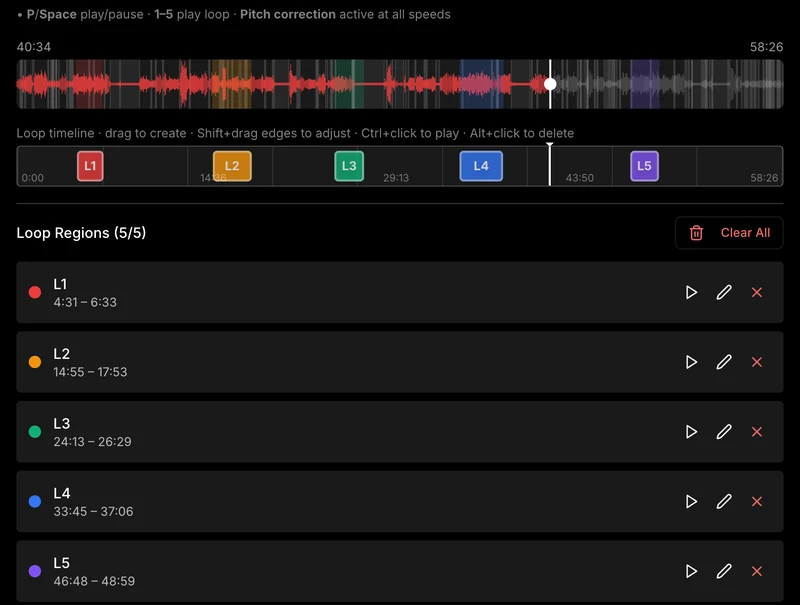
Loop the hard part
Mark up to five loop regions on any class recording, slow it down with the pitch kept true, and skip the silences.
Homework with clear goals
Each assignment sets out compulsory goals and extra-credit goals. You hand in a video or a file, and your teacher grades it and writes you feedback.
- Class recordings, kept for you after class
- Notes and study material for each classroom
- Your grades, attendance and hours
- A community for your class
Free practice apps
Made by the school, free for everyone, and they open in your browser on a phone or a computer.
- Pitara: A music desk: play any chord or scale on a piano with live notation, plus a tuner, metronome and tanpura.
- Woodshed: Log your practice, keep your goals and song packs, and see your teacher's tasks and your streak in one place.
- Prima Vista: Sing what is on the stave, and the app marks every note for pitch and timing.
- Chord Trees: See how chords connect as trees on the piano, then build a progression and play it back.
- Span: Learn every interval by ear, eye, hand and voice from one screen.
- Pendulum: Drill pulse and scale-degree patterns in Western, Hindustani or Carnatic note names.
- Cadence Library: Hear 25 ways to end a familiar tune, and practise each ending in any key.
See all our free practice apps
What makes us different
Many places start with a tune, add the rest later and work towards an exam piece. We do it the other way round. Here is what that means in a lesson.
- Bottom-up, not melody-first. Rhythm, chords and ear training come first, so a melody makes sense when it arrives.
- Both hands from the first class. Two hands play together from your first piano lesson, and by the end you are trained to play both solo and as an accompanist.
- A musician first. Theory, ear training, rhythm and transcription run through everything, so you can work a song out by ear, not only read it.
- Rhythm is a subject. Konnakol, Afro-Cuban claves, swing and odd metres like 7/8 are taught properly, not left to chance.
- Many musical cultures, one course. Western harmony, Indian swaras and ragas, Latin rhythm, gospel, blues and Bollywood sit side by side.
- Skills, and our own certificate. You build skills you use in real music, and earn our Music Method certificate through homework, attendance and the class community.
- Placed by a musician, planned by hours. If you already play, Jason Zac listens to your clip and places you. Beyond Foundation you choose hours, not a grade.
- Bring your own song. In Music Factory you take a song you love apart, chord by chord, to understand why the composer chose each one.
Want to see how a lesson would work for you? Ask us anything. Enquire now · WhatsApp us
Since 2008
Eighteen years of teaching music in Bangalore and online, with the Music Method at the heart of it since 2009.
- 2008: The school opens in Bangalore. Jason Zac and Lillian Zachariah found Nathaniel School of Music.
- 2009: The Music Method begins. A performance-based course built to make a complete musician of you. Jam sessions, gigs and student concerts have been part of it for years.
- 2014: A graded certificate course. The Music Method becomes a graded certificate course, with every student evaluated on their assignments.
- Two studios: Langford Town and Sahakar Nagar. Music classes in Bangalore at two studios, central and north, for students who want to learn in person.
- Online: Live classes, wherever you are. Today about nine in ten of our students learn live online, from 20+ countries, with every class recorded on our own learning portal.
- YouTube: Free lessons for everyone. Jason Zac's channel has more than 1,000 free lessons and 120,000+ subscribers.
What the school is known for
- Teaching from the bottom up: rhythm and harmony before melody
- 3D lessons: technique, theory and ear in the same class
- Jam sessions and student concerts
- Jason Zac's theory classes
What students say
Quoted word for word from our Google listing in Langford Town. Where a review was long we have shortened it, and the cut is marked with an ellipsis.
4.3 from 250 reviews on Google. Read every review on Google
An absolutely analytical step by step learning of Music theory and the practical Piano classes are just superb. The teaching technique is very structured and I found this totally different from any other course known to me. I'm fortunate enough to come across my guide Jason Zac whose in depth knowledge, patience, skill and the structured way of teaching for all levels online inspire me all the time to love the instrument and go forward while understanding the basics of music. Recommended for any one who is serious in learning music with any instrument at any age and at any skill level.
Sumita · Google review · 5 stars · 4 years ago
I am just completing the online Piano course and had an outstanding experience with the Nathaniel School. I have tried other online piano programs previously but this was by far the best. The teacher started from the very basics that would accommodate a complete beginner but everything was scaleable so the player with more experience was also challenged. … The ‘batches’ of students were kept small enough that it was a great supportive environment and all the students encouraged the others to play their best. Technically the classes were very well run and I had no problems interacting in real time with the teacher and other students despite being halfway around the world. …
kvd1 · Google review · 5 stars · 5 years ago
I am a retired principal beyond 60 years of age. I could sing in a choir but clueless about any musical note or scale or major or minor. Having joined the Beginner level of the Music course with Nathaniel School of Music, I have gained something very remarkable through both theory and practical sessions. … Our homework and assignments really helped us to perform well and made us try new creative stuff on the piano. Posting our performances in the course group helped us to learn from each other and appreciate and encourage one another. Much of the musical language which sounded Greek and Latin initially, made sense to me during this unimaginable online course. …
Renita · Google review · 5 stars · 4 years ago
Learning from Jason Sir has been an absolute privilege and pleasure—he makes difficult concepts easy to understand, gives us practical exercises, and ensures every student gets personal attention, even in group classes. His sessions go beyond just teaching piano—they’ve helped me grow as a musician in ways I never imagined.
It’s one of the best places to learn piano due to its contemporary approach, and the school keeps learning engaging with workshops and innovative methods. … I wholeheartedly recommend Nathaniel School of Music and their Music Method course!
Srilatha · Google review · 5 stars · a year ago
I have been learning piano with Jason Zac at Nathaniel now for over a year after discovering his amazing videos on YouTube.
Jason is an incredible teacher, he has a natural ability to teach complex methods but in a way that is easy to understand. As I live abroad, lessons are done online via Zoom and Jason checks in during the week in a private WhatsApp group to review homework, etc, as well as answering any questions I have.
I'd highly recommend Jason from beginners through to advanced players, you wont regret it.
Adam · Google review · 5 stars · 3 years ago
I am so happy I made the decision to join this school! The brains behind the method of teaching is Jason Zac, and he is a brilliant teacher and master musician. Over the last few weeks I have leveled up, and am in the process of leveling up, in ways I never dreamed possible. My skills and my confidence to handle many unique musical circumstances - from composing to re-harmonizing chord progressions to improvising in Indian Carnatic ragas - are growing exponentially. …
Crystal · Google review · 5 stars · a year ago
… I did the level 1 vocals, and a level 1 and level 2 in keyboard. The curriculum is very well designed. I loved the theory classes with Jason. Even theory was taught in a very practical manner. … I had never played keyboard before in my life but within 8 months time I could pick up quite a bit. Along with the learning, the experience of jamming with a band, performing at the concert and recording in a studio is something that I loved. …
The school is a great place for anyone who is sincere about music. You will have to put in the hard work and the hours but you will learn a ton.
Khushpinder · Google review · 5 stars · 7 years ago
Excellent curriculum. What stands out is the passion from jason sir and his details on music sessions. Kids get motivated and benefit from encylopedia of information he provides. His youtube videos are a great plus. We also had a chance to attend his practice workshops that gives a forum to interact with other students in person.
Jason video class recordings are shared to students and archive them for any future reference for kids.
Arun · Google review · 5 stars · 3 years ago
… She had an amazing experience at the institute. They have a very good methodology of teaching. The theory classes taken by Mr. Jason are the best. Jam Sessions gave her a lot of scope to explore new things. …
Sathya · Google review · 5 stars · 8 years ago
Our students on stage
Jam sessions and student concerts are part of learning here. A few of our students on stage.
Ready when you are. We reply within 24 hours, Monday to Saturday. Enquire now · WhatsApp us
Founded by two musicians who never stopped teaching.
Jason Zac and Lillian Zachariah started Nathaniel School of Music in 2008 with a simple conviction: that anyone, at any age, can build a real and lasting relationship with music when they are taught with patience and craft.
Today that is two Bangalore studios, live online classes and more than 6,000 students taught.
- Jason Zac, Co-founder · Pianist and producer. Leads the school's teaching philosophy: music as a language, learned by listening.
- Lillian Zachariah, Co-founder · Vocalist and educator. Shapes the vocal and Foundation programmes, and the warmth the school is known for.
Meet all our teachers · Our story
Where you learn
Music classes in Bangalore at our Langford Town and Sahakar Nagar studios, and live online wherever you are.
Langford Town
G1 Tuscan Sharifa, No. 10, N Street, Berlie Street Cross, Langford Town, Shanti Nagar, Bangalore - 560025 · Open in Google Maps
Sahakar Nagar
194, 10th Cross, F/G Block Road, G Block, Sahakar Nagar, Bangalore - 560092 · Open in Google Maps
Live online, worldwide
Classes on Zoom from wherever you are, with every recording on your student portal. Students join us from 20+ countries.
Tell us what you want to learn
Three short steps, mostly taps. We reply within 24 hours, Monday to Saturday.
Send us an enquiry · WhatsApp: +91 98454 65411 · Call: +91 77604 56847 · Email: music@nathanielschool.com
Calls Mon to Sat · 9:00 am to 6:30 pm IST
Before your first lesson
The questions people ask us most before they join.
How much do the courses cost?
Fees are set by hours over a six-month semester. In India, the Music Method Foundation (32 hours) is ₹20,000 + 18% GST, the same for piano, guitar and vocals, and the 40, 50 and 65 hour plans for players beyond Foundation are ₹22,500, ₹27,500 and ₹35,000 + 18% GST. Outside India, Foundation is $420 + 7% PayPal fee, and every plan is on our Fees page.
Can I learn online, or only in Bangalore?
Both. Most of our students learn online in live Zoom classes, and in Bangalore you can also join in person at our Langford Town or Sahakar Nagar studios. In-person places depend on the batch, so tell us which you prefer when you enquire.
I'm a complete beginner. Can I join, and how do I know my level?
Yes. Our Foundation course starts from the very first note and needs no experience. If you already play, send us a short clip of your playing when you enquire and Jason Zac will suggest the right level.
When are the classes?
We run several live classrooms across the week, and the right one depends on your level and your city or time zone. Tell us the days that suit you when you enquire, and we'll tell you what is open.
How do I enrol, and what happens next?
Fill in the enquiry form or WhatsApp us. We'll reply within 24 hours, Monday to Saturday, to learn about your goals and suggest a course. Once you enrol you get a login to our learning portal for your classes, recordings and homework.
Are classes live or recorded? What if I miss one?
Classes are live. Every class is recorded in HD and shared with you privately on our learning portal after class, along with your notes and homework, so you can catch up.
How long is the course and how many classes will I have?
The Foundation course is 32 lessons over up to six months: 20 practical lessons on your instrument and 12 theory and ear-training lessons. Expect about one practical lesson a week plus theory every other week. The longer plans add more classes.
What ages do you teach?
From age 7 to 75+. There is no separate syllabus for children and adults: your teacher sets the pace for each student. Tell us the age when you enquire and we'll suggest what fits.
Are lessons in a group or one-to-one?
Our courses are taught in small live groups, which is also how students pick up ideas from each other. If you want one-to-one teaching, our Customised private plan is 20 private lessons over six months; enquire and tell us what you need.
Do I need my own instrument at home?
Yes, you'll need one to practise between classes. For piano, a 61 to 88 key touch-sensitive keyboard (a 61-key one is about ₹11,000 to ₹12,000); for guitar, a basic acoustic (about ₹7,000 to ₹9,000). We'll help you choose once you've enrolled.
I live outside India. Can I join?
Yes. Our online classes are live on Zoom with recordings, and we've taught students in more than 20 countries. WhatsApp us your country and time zone and we'll tell you what works.
What do you teach?
Piano and keyboard, guitar and vocals, along with music theory and ear training. We don't teach other instruments at the moment.
Home · About · Courses · Fees ·Faculty · Our Students · FAQ · Contact · Piano · Guitar · Singing · Free tutorials